
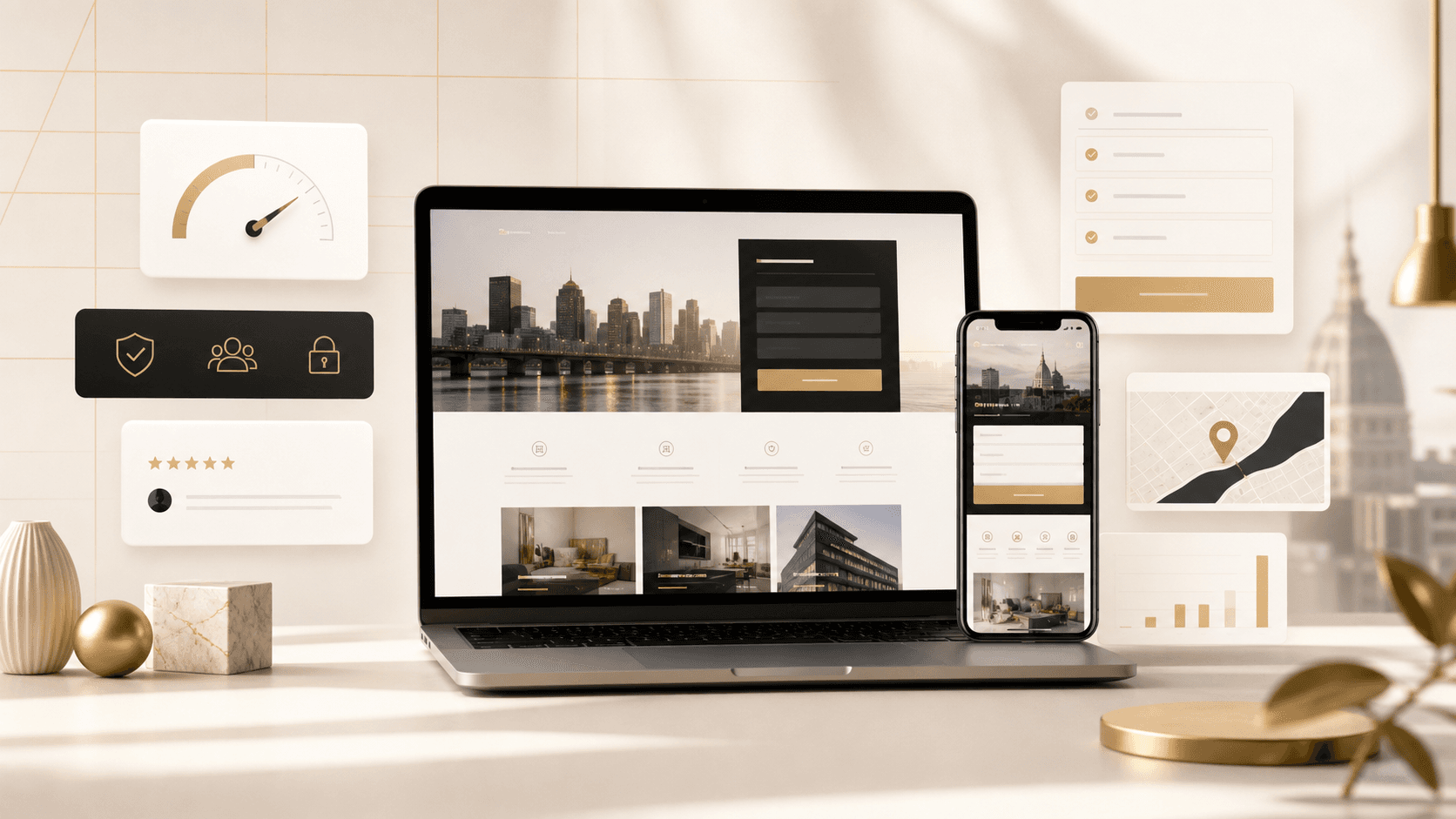
Why web design matters for local businesses
Core Focus: For service-area businesses and professionals, web design should bridge the gap between discovery and trust. We build websites that convert traffic from SEO, local search, and ads into paying clients.
We build fast, secure, and SEO-optimized websites that establish professional credibility and provide a frictionless path for users to contact you.
A website shouldn't just be an online brochure; it needs to be your most reliable salesperson. If your website is slow, hard to navigate on mobile, or hides your call to action, visitors will leave within seconds.
Fair Tower Consulting designs websites tailored specifically for local businesses. We structure your navigation around core services, optimize loading speed, and embed trust signals (reviews, project photos, process steps) near call-to-action buttons.
Every layout is engineered with SEO in mind from day one. You receive an indexable, responsive platform structured to support search visibility and conversion optimization.
Montreal buyers often compare several local providers quickly. A website that feels vague, slow, or generic can make a strong business look less credible than a weaker competitor with clearer presentation.
Service breakdown
What we focus on
Design is a trust decision
People do not evaluate a local business website like designers do. They ask faster questions: Is this business real? Do they offer what I need? Are they close enough or able to serve me? Can I understand pricing, process, or next steps? Does this feel professional enough to contact?
Good web design answers those questions without making the visitor work. The page structure, copy, photos, calls to action, forms, and mobile layout all shape whether a visitor becomes a lead or silently leaves.
- Clear hero sections that explain the offer quickly
- Service pages that match what buyers search for
- Proof points placed near decision moments
- Forms and phone links that are easy to use on mobile
SEO-ready structure from the beginning
A beautiful site can still underperform if it has poor structure. SEO-ready web design means the site is built with clear pages, crawlable content, logical headings, internal links, fast performance, and metadata that supports search intent.
We plan the website around services and local visibility before the design is locked. That prevents the common problem of launching a nice-looking site and then discovering that the pages are too thin, too slow, or too hard to optimize.
- Plan navigation around the services that generate revenue
- Build reusable sections without duplicating thin copy
- Keep page speed and accessibility in scope
- Use schema and metadata where they support clarity
Conversion details that change results
Conversion is usually improved by removing small points of hesitation. A better headline, clearer service breakdown, stronger proof, simpler form, visible phone number, or more helpful FAQ can change how many qualified visitors take action.
For local businesses, the website should also connect cleanly with the Google Business Profile, ads, analytics, and call tracking. If the site becomes the place where traffic turns into revenue opportunity, design decisions need to be measured, not guessed.
- Use CTAs that match the buyer's readiness
- Place trust signals before high-friction actions
- Make forms short enough to complete
- Track calls and submissions by page where possible
Local relevance
Built for businesses competing in Montreal
Montreal buyers often compare several local providers quickly. A website that feels vague, slow, or generic can make a strong business look less credible than a weaker competitor with clearer presentation.
We plan the work around real buyer behavior in Downtown Montreal, NDG, Westmount, and nearby markets like Laval.
What we evaluate
| Area | What we review | Business impact |
|---|---|---|
| Trust | Clear positioning, proof, photos, reviews, process | Visitors feel safer contacting you |
| SEO | Page structure, headings, internal links, speed | Search engines understand the site |
| Conversion | CTAs, forms, phone links, mobile UX | More visitors become leads |
Simple checklist
Before investing more, check the basics.
- The homepage explains who the business helps and what to do next.
- Each major service has its own indexable page.
- The site loads quickly and works cleanly on mobile.
- Calls, forms, and important clicks are tracked.
- Copy sounds specific to the business, not like a template.
Related services
Services that work with web design
Landing Page Design
Fair Tower Consulting helps Montreal businesses use landing page design to make better decisions, strengthen trust, and turn local search attention into qualified leads.
Conversion Rate Optimization
Fair Tower Consulting helps Montreal businesses use conversion rate optimization to make better decisions, strengthen trust, and turn local search attention into qualified leads.
SEO
We build SEO systems that help buyers understand what you do, help Google understand why you deserve visibility, and help your team turn organic traffic into qualified leads.
Local SEO
Fair Tower Consulting builds local search systems that help qualified businesses appear where buyers look first: Google Maps, organic local results, and service pages tied to real buyer intent.
Google Ads
Paid search should put your business in front of people already looking for your service, then send them to a page that makes calling or booking feel obvious.
Areas served
Areas we serve
Montreal
Local marketing strategy for businesses competing across Montreal.
Côte-des-Neiges
Visibility help for clinics, service businesses, and local operators in CDN.
NDG
Search and website support for businesses serving Notre-Dame-de-Grâce.
Westmount
Premium local visibility for professional firms, clinics, and boutiques.
Downtown Montreal
Local search strategy for high-competition downtown markets.
FAQ
Questions local business owners ask
Do you build websites with SEO included?
Yes. SEO structure, page planning, metadata, internal links, speed, and service content are considered during the build instead of added as an afterthought.
Can you redesign an existing site?
Yes. We review what is currently working, what is limiting trust or visibility, and what should be preserved before rebuilding.
What makes a website convert better?
Specific positioning, clear service pages, visible proof, fast mobile performance, low-friction forms, and calls to action that fit the buyer's intent.
Do I need custom photography?
Not always, but real photos often help local trust. If custom photos are not available, the design still needs visuals that feel credible and specific.
Will the site support Google Ads?
Yes. We can build landing pages and tracking paths that support paid search campaigns as well as organic traffic.
How many pages should the new site include?
At minimum, the site should cover the homepage, core services, trust/proof, contact path, and any local pages that genuinely help buyers and search engines.